
How Much Solar Power Does a Tiny Home Need?
Andrea | 11/26/2026
How Much Solar Power Does a Tiny Home Need?
A tiny home doesn't need a huge solar setup, but it does need one that's sized for your daily electricity use. The right system depends on your appliances, how many hours you use them, and how much sunlight your location gets.
You can work this out in four steps: calculate your daily energy use, estimate the number of solar panels you need, size your battery bank, and choose an inverter that can handle your appliances.
This guide walks you through each calculation with examples. The appliance figures are sample numbers to demonstrate the math, so use the actual wattages and energy ratings of the appliances you plan to run.
How much solar power does a tiny home need?
There's no standard solar system size for every tiny home. It depends on how much electricity you use each day and how much sunlight your panels receive.
One off-grid tiny house in California used an average of about 3.7 kWh per day. With four peak sun hours, that would require roughly 1.2 kW of solar panels. For comparison, the average U.S. home uses about 29.6 kWh per day, so a tiny home generally needs a much smaller system.
Three things determine how much solar power you'll need:
Daily energy use: How much electricity your appliances consume in a typical day
Peak sun hours: How many hours of usable sunlight your panels receive
Battery storage: How many days you want your system to run without much sunlight
Here are two useful benchmarks:
Average U.S. home: Used 10,791 kWh in 2022, or about 899 kWh per month, according to the U.S. Energy Information Administration.
Off-grid tiny house in California: A 199-square-foot home with two occupants used an average of 1,343 kWh per year over three years, or about 3.7 kWh per day, according to a Journal of Green Building study.
The California home is a useful example, but its energy use isn't a universal target. It has a relatively mild climate and uses an air-to-water heat pump.
For more examples of homes designed around independent power systems, check out this $50K off-grid tiny home that generates power, collects water and grows food and the Ecocapsule.
How do you calculate your tiny home's daily energy use?
Start by listing every electrical appliance and device you plan to use. Multiply each item's wattage by the number of hours you use it per day, then divide by 1,000 to get its daily energy consumption in kilowatt-hours (kWh).
This is the standard calculation published by the U.S. Department of Energy.
Follow these steps:
List all your electrical appliances and devices, including smaller items such as lights, routers, and ventilation fans.
Check the wattage on each appliance's label. If it only lists volts and amps, multiply the two numbers to get watts.
Estimate how many hours you use each appliance per day.
Multiply the wattage by the daily operating hours to get watt-hours (Wh). Add everything together to find your total daily energy use.
For refrigerators, check the annual kWh figure on the EnergyGuide label instead of using the rated wattage. Refrigerators cycle on and off throughout the day, so their actual energy consumption is lower than running them at full power for 24 hours.
Here's an example using a small selection of appliances:
Appliance (sample) | Rating | Hours per day | Energy use per day |
|---|---|---|---|
LED lighting | 30 W | 5 | 150 Wh |
Laptop | 50 W | 6 | 300 Wh |
Router | 10 W | 24 | 240 Wh |
Vent fan | 30 W | 8 | 240 Wh |
Water pump | 100 W | 0.5 | 50 Wh |
Small refrigerator | 255 kWh/year | 24 | 700 Wh |
Total | 1,680 Wh (1.68 kWh) |
These sample figures represent a relatively low-energy home without electric heating or cooking. Your total will increase if you use appliances such as a microwave, washing machine, electric heater, or hair dryer.
You can use the same calculation for every appliance you plan to add. It's worth doing this before buying your solar equipment, since even a few high-energy appliances can change the size and cost of your system.
How many solar panels does a tiny home need?
Once you know your daily energy use, you can estimate the solar panel capacity you need.
Divide your daily watt-hours by your peak sun hours multiplied by 0.75. The 0.75 accounts for energy losses from heat, wiring, the inverter, and dust.
Solar panel capacity (W) = Daily energy use (Wh) ÷ (Peak sun hours × 0.75)
A peak sun hour is equivalent to one hour of sunlight at an intensity of 1,000 watts per square metre.
For example, a tiny home that uses 3,700 Wh per day and receives four peak sun hours would need:
3,700 ÷ (4 × 0.75) = 1,233 W
That means you'd need approximately 1.23 kW of solar panels.
The 0.75 performance ratio is also used by Natural Resources Canada in its photovoltaic potential maps. An older NREL PVWatts report uses a similar default of 0.77.
Your location makes a big difference. You can check estimated peak sun hours using the NREL PVWatts Calculator for U.S. locations or Natural Resources Canada's solar resource maps, which cover more than 3,500 Canadian municipalities.
The following table shows how the same daily energy requirements change with four versus two peak sun hours. These are assumed values for illustration, not estimates for a specific location.
Daily energy use | 4 peak sun hours | 2 peak sun hours |
|---|---|---|
Sample loads, 1,680 Wh | 560 W | 1,120 W |
California benchmark, 3,700 Wh | 1,233 W | 2,467 W |
To work out how many panels you'll need, divide the required panel capacity by the wattage of the panels you're considering.
For example, if your system needs 1,200 W and you're using 400 W panels, you'll need three panels.
Don't forget to check their physical dimensions and make sure you have enough roof space. If you plan to rely on solar throughout the year, use the sunlight estimates for your least sunny month rather than sizing your system around summer conditions.
What size battery bank does a tiny home need?
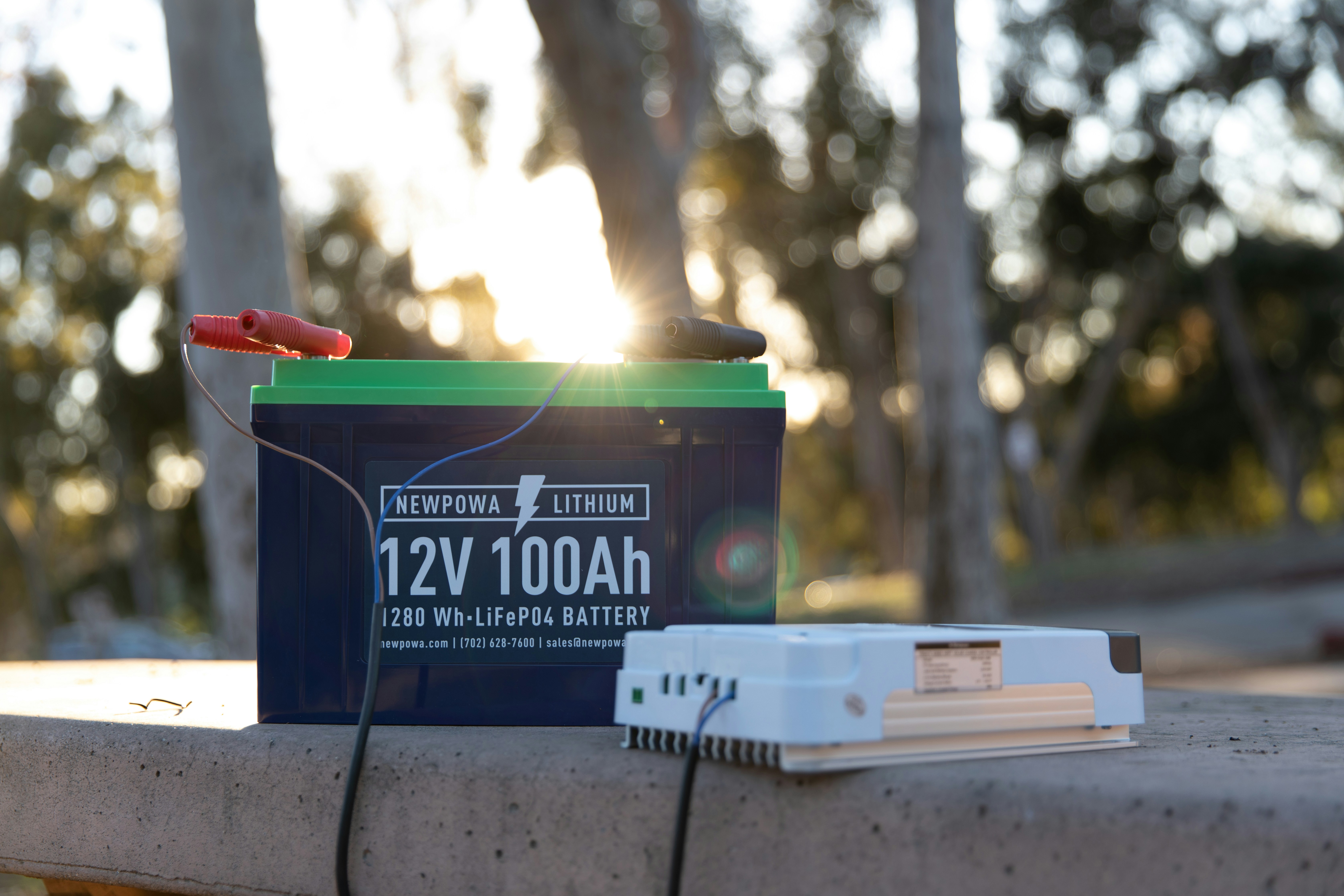
Your batteries store the electricity your panels generate so you can use it at night or during cloudy weather.
The size of your battery bank depends on your daily energy use, how many days you want to run without sufficient sunlight, and how much of the battery's capacity you can safely use.
This last factor is called the usable fraction or depth of discharge. For example, a deep-cycle lead-acid battery is generally designed for a 50% daily discharge. That means you'll need twice the capacity of the electricity you want to use.
Use this formula:
Battery capacity (Wh) = Daily energy use (Wh) × Days of autonomy ÷ Usable fraction
Days of autonomy refers to how many days your battery bank should power your home without enough solar generation to recharge it.
Here's what a two-day backup would look like using the sample energy requirements:
Daily energy use | Days of autonomy | Lead-acid battery capacity (50% usable) |
|---|---|---|
Sample loads, 1,680 Wh | 2 | 6,720 Wh |
California benchmark, 3,700 Wh | 2 | 14,800 Wh |
Two days is just an example. You can choose more or less battery storage depending on your climate, backup power options, and how much flexibility you want during cloudy weather.
You can also convert watt-hours to amp-hours by dividing the battery capacity by your system voltage.
For example, a 6,720 Wh battery bank on a 12 V system would need 560 Ah of capacity.
If you're using lithium batteries, check the manufacturer's specifications for usable capacity. Lithium batteries generally allow a higher percentage of their rated capacity to be used than lead-acid batteries, so you shouldn't automatically apply the 50% figure.
Temperature is another consideration, particularly if your batteries will be stored in an unheated space. According to Morningstar, lead-acid battery capacity can drop by around 20% to 25% at 32°F (0°C) and by about 50% at 0°F (-18°C).
What size inverter does a tiny home need?
Your inverter needs to handle the combined wattage of the appliances you might run at the same time.
For example, a 1,500 W electric kettle needs an inverter rated above 1,500 W, even if it's the only appliance running. If you also want to use a microwave or other appliances at the same time, you'll need to account for their combined wattage.
Some appliances, particularly refrigerators and water pumps, also need extra power when their motors start. This is called surge power. Check both the continuous and surge ratings on an inverter's specifications before buying.
An inverter converts the direct current (DC) electricity stored in your batteries into alternating current (AC), which most household appliances use.
Voltage is important, too. Most U.S. household appliances run on 120 V, while electric cooktops and clothes dryers often require 240 V, according to the U.S. Department of Energy. If you plan to use 240 V appliances, make sure your inverter supports that output.
What changes the solar power requirements most?
Electric heating and winter sunlight can have the biggest impact on your solar requirements.
A 1,500 W electric heater running for four hours a day uses 6 kWh of electricity. That's more than the entire daily energy consumption of the California tiny home in our earlier example.
At four peak sun hours, that heater alone would require another 2,000 W of solar panels:
6,000 Wh ÷ (4 × 0.75) = 2,000 W
This is why it's important to decide how you'll heat your tiny home before choosing your solar system.
The California study found that space heating accounted for more than 30% of the home's design energy load when heating was in use. Its requirements were relatively low because of its well-insulated construction and mild climate.
Your heating needs could be considerably higher in a colder location.
One option is to use a wood stove or propane heater instead of relying entirely on electricity. This reduces the amount of power your solar system needs to supply, although you'll have to plan for fuel storage and regular replenishment.
For a closer look at your options, see our guide to How to Heat a Tiny Home in Winter.
If you'd rather use electric heating, compare the wattage and energy consumption of different models before sizing your system. Our 5 Best Compact Heaters for Tiny Homes is a good place to start.
How can you reduce the size of your solar system?
The easiest way to reduce your solar requirements is to use less electricity in the first place.
Every watt-hour you save means you need less solar panel capacity, battery storage, and potentially a smaller inverter. A few practical changes can make a noticeable difference:
Use alternative heating and cooking methods. A wood stove or propane appliance can reduce your dependence on electricity, provided they're suitable for your home and location.
Choose energy-efficient appliances. Compare the annual kWh figures on refrigerator labels and look for appliances with lower energy consumption.
Run larger appliances during the day. Use your washer, water pump, and other high-energy appliances while your panels are generating electricity.
Review your energy use regularly. Recalculate your daily requirements whenever you add or replace an appliance.
These changes can help you avoid paying for a larger solar system than you actually need.
How much solar power should you plan for?
The best way to size a tiny home's solar system is to start with your actual electricity use rather than choosing a panel or battery package based on the home's square footage.
Calculate your daily watt-hours, use your location's peak sun hours to estimate the panel capacity, and size your battery bank around the number of backup days you want. Your inverter should also be able to handle the combined wattage of appliances running at the same time.
Pay particular attention to winter conditions and heating requirements. A system that works well in summer might struggle during shorter, cloudier days.
Finally, check your local electrical codes and permit requirements before installing anything. Have a licensed electrician review your system design to make sure the components are compatible and the installation is safe.
FAQ
How many solar panels do I need for a tiny house?
It depends on your daily electricity use and the amount of sunlight your location receives. Divide your daily watt-hours by peak sun hours multiplied by 0.75 to calculate the total panel wattage. Then divide that figure by the rated wattage of your chosen panels.
For example, the sample loads in this guide need 560 to 1,120 W of panels at four and two peak sun hours, respectively. The California tiny home benchmark needs approximately 1,233 to 2,467 W.
Can a tiny house run entirely on solar power?
Yes. A properly sized solar system with enough battery storage can power a tiny home independently. The main challenges are high-energy appliances, electric heating, and reduced sunlight during winter. You may need a backup generator or alternative heating source to keep your system reliable throughout the year.
What size solar system do I need for a 200 sq ft tiny house?
The size of your home doesn't determine how much solar power you need. Your daily electricity consumption does.
For reference, a 199-square-foot off-grid tiny home in California averaged 1,343 kWh per year, or about 3.7 kWh per day. That would require approximately 1,233 W of solar panels with four peak sun hours.
How many batteries do I need for a tiny home?
Calculate the total battery capacity you need in watt-hours, then divide it by the usable watt-hours of one battery. Round up to the next whole battery.
For example, the sample two-day battery bank in this guide requires 6,720 Wh of lead-acid storage, equivalent to 560 Ah on a 12 V system.
Can a portable power station run a tiny home?
A portable power station can run smaller appliances and essential devices, but its capacity and output determine how much of your home it can power.
Compare its rated watt-hours with your daily electricity consumption and its maximum output wattage with your largest appliances. If it stores less than one day's worth of electricity, it won't provide a full day of backup without recharging.
Comments (0)
No comments yet. Be the first to share your thoughts.